
AVENUE LIVING REAL ESTATE CORE TRUST - ANALYSIS REPORT
Oct. 2025
PRESENTED BY:
GEORGE HSU - Product Manager & Toronto Branch Manager
PEIXIAN QUEK - Investment Analyst

ANALYSIS REPORT
Avenue Living Real Estate Core Trust (The Trust) has delivered 6.09% return year-to-August, which is on track to achieve its annual target of 8-12%, net of fees. It has outperformed peers and similar products thanks to its differentiated positioning (multifamily units in Ca-nadian prairie provinces coupled with an increasing presence in the U.S.) and the econo-mies of scale driven by a growing AUM. We see less of a cash flow risk to the Trust as it sits with a strong total available liquidity (more than 11 times of the amount of the committed cash outflow in 2Q25), and continues to deliver better-than-industry revenue growth and margin expansion. Our key due diligence findings are summarized as follows.
Improving operational efficiency in 2Q25. Although the inflationary cost pressure remained in place across different sectors, the Trust continued to deliver improving same-door net operating income (NOI) margin in 2Q25 (69.8% vs. 68.6% in 1Q25), which was mainly aided by the economies of scale in the U.S. market. The same-door revenue was also growing in tandem with the same-door NOI at over 4% YoY during the period.
Expanding by equity issuance, rather than by financial leveraging. The Trust has an ambitious capital demand for the U.S. expansion and countercyclical investment in Canada. The expansion is not supported by financial leveraging (LTV remained stable at 49.5%), but by the new unit issuance and its own balance sheet. On top of strong issuance YTD, the Trust plans to raise $550 million by end of this year. Management’s holdings have increased over the past year.
Business operation is strong to cover the commitment. The Trust has a solid oper-ation and profitability that is sufficient to cover all of committed payment (net distri-butions and redemptions combined at $45.8 million in 2Q25, made up only 76% of the NOI during the quarter). Besides, the Trust’s total available liquidity remains solid at$523 million as of June 2025, which is more than 11 times higher than the cash outflow in 2Q25.
New Issuance not a dilution to the performance, but strengthen the future growth prospectus. The new issuance in 2Q25 contributed to only 2% growth QoQ in the Trust’s total investments; meanwhile, the Trust recorded 10% NOI growth QoQ during the quar-ter. That said, the new issuance should not be seen as a dilutive factor to the portfolio; instead, it is more like an incremental capital resource for new acquisition opportunities to drive long-term growth.
What risks deserve our close watch? We highlight three potential risks which should not be ignored. Firstly, interest rate risk. We should continue to watch if rate changes in Canada and the U.S. would have any implication to the portfolio and if such a shift would squeeze the Trust’s margin. The second risk is related to market risk (including cap rate and FX) and execution risk in the U.S. due to a notable increase in exposure (which will likely make up 30% of the portfolio by end of 2025). Lastly, Class W/W-U unitholders pose a decision-making risk, as they hold around 60% of the Trust’s total outstanding units and therefore exert substantial influence on the Trust.

RETURNS:
OUTPERFORMING PEERS & ON TRACK TO ACHIEVE ANNUAL TARGET

Avenue Living Real Estate Core Trust (The Trust) has delivered 6.09% return year-to-August, which is on track to achieve its annual target of 8-12%, net of fees, despite the challenging market landscape. While the Trust’s return was lower than that of the same period last year, it has notably outperformed its peers as well as some other real estate-related products. The Trust’s resilience compared to peers can be attributed to (1) its differentiated portfolio positioning and geographic focus (multifamily units in Canadian prairies provinces cou-pled with an increasing presence in the U.S. where there is less of an oversupply issue, but a supply shortage), (2) the economies of scale driven by a significant growth in invest-ments and the AUM this year (an incremental $1.4 billion net fund inflow to Avenue Living during 1H25), and (3) an improved operational efficiency (capital structure optimization, enhanced owner-operator model, improving same-door margin, etc.). On the other hand, the Trust has increased its NAV twice this year thus far, firstly in February by 1.3% to $12.56, and again in August by 1.4% to $12.73 (Class D).

BUSINESS UPDATES: THE U.S. A NEW PIVOT DRIVING GROWTH
As data from Statistics Canada and Canadian Real Estate Association has shown, Cana-da’s housing index has continued to be under pressure year-to-date, although we have seen a silver lining in the form of a pickup in home sales volume. Prevailing conditions in the Canadian real estate market have resulted in muted returns across the majority of REIT-related products. Therefore, the Trust has adopted an expansion strategy that aims to achieve economies of scale to boost (or at least sustain) the portfolio’s performance. During 1H25, the Trust undertook an aggressive expansion in the U.S., driven by a growing pipeline of opportunistic investments - supported by declining homeownership rates that have strengthened rental demand, as well as a favorable funding cost differential between Canada and the U.S. In Canada, the Trust launched a countercyclical capital expenditure program with a target to renovate around 2,000 units, which in turn could help drive growth in average rent. The Trust currently has around $600+ million of conditional acquisitions under contract.
Expansion on Equity Issuance, Not Financial Leveraging
More importantly, the Trust’s expansion is not driven by financial leveraging (Loan-to-Val-ue remained stable at 49.5%); instead, it is mainly supported by the new unit issuance as well as the Trust’s own balance sheet. On top of strong issuance YTD, the Trust has elected to extend its expansion to the earlier of December 15, 2025 or until a total of $550 million has been raised under the expansion initiative. This decision was based on the back of strong investor demand, as the Trust had earlier launched an expansion offering in May 2025 tar-geting $350 million that was oversubscribed one month ahead of schedule. The Trust’s total available liquidity remains solid at $523 million as of the end of June 2025 (versus $512 million as of the end of December 2024, and $479 million as of the end of March 2025).

Long-Term Targeting 40% Portfolio Exposure to the U.S.
The Trust has seen its total number of U.S. residential units grow from c8% of the portfolio in August 2024 to c25% in August 2025, and the number is expected to further increase to around 30% by end of this year as per management. Management has set a medium to long-term target of a 40%/60% geographic split between the U.S. and Canada. We believe such a geographic shift could help the Trust diversify its market risk in Canada, and also tap on the growth potential in the U.S. market. Historically the capitalization rate (cap rate) in the U.S. is generally higher than in Canada, and such a trend still holds under the current market backdrop. The Trust has only focused on those with >5% cap rate south of the bor-der to partly alleviate the risk of volatility in both acquisition prices and rental income.


The Trust acquired 314 units for $71.5 million in the U.S. heartland, and 1,934 units for $348.9 million in Iowa during 1H25. This is an astute move, in our view, given that a decline in multi-family construction starts in the U.S. would likely jeopardize the existing issue of sup-ply shortage, which could potentially help the rent growth of the portfolio.
OPERATIONAL HIGHLIGHTS:
STRONG RENT GROWTH MOMENTUM
The Trust’s weighted average occupancy rate rose to 94.7% in 2Q25 from 93.9% in 2Q24. Coupled with average rent growth of 9% YoY, this underscores the Trust’s pricing power, particularly in the face of prevailing market headwinds. It is worth noting that several major Canadian cities (including Toronto, Vancouver, Calgary, and Halifax) had experienced YoY rent declines over the same period, which was largely attributable to weakness in the con-dominium market. However, the Trust’s multifamily portfolio serves a different tenant base that primarily consists of the domestic working class.

The Trust Has Resilient Average Rent Trend
Although the Trust’s average rent softened slightly by 0.4% QoQ to $1,517 in 2Q25 from $1,523 in 1Q25, we believe this would likely result from (1) differences in completion timelines of newly renovated units, (2) renewals outnumbering new leases, and (3) balancing rental growth and occupancy rates. It is worth noting that the growing supply in the Canadian real estate market, particularly for Class A condos, has less impact on the Trust thanks to its differentiated position in multifamily affordable units and exposure to prairie provinc-es. Such a positioning drove the Trust’s average rent further strengthen over the past two quarters, with the gap-to-market narrowing significantly to $130 (8.6% gap-to-market) per suite in 2Q25, comparing to $209 (15% gap-to-market) in 2Q24 or $140 in 1Q25.
The Trust also delivered a stronger net operating income (NOI) growth both on a YoY and QoQ basis that outpaced revenue growth in 2Q25, mainly aided by achieving the economies of scale through an increased presence in the U.S. (U.S. same-door NOI margin improved to 63.4% in 2Q25 versus 60.4% in 2Q24). This reflects the more cost-efficient outsourced property management model in the U.S., which amounts to just 2.5% of annual gross in-come (versus Avenue Living’s in-house property management cost of 4%, and 7-10% for outsourced property management services in Canada). The Trust’s investments in Canada also experienced higher expense pressures, largely driven by inflationary cost increases that compressed same-door NOI margin to 70.5% from 71.2% during the same period.
Most of the Trust’s U.S. properties are outsourced to Asset Living, which is a third-party prop-erty management firm founded in 1986 with operations in over 40 states across the U.S. The firm provides management services for a wide range of property types including student, affordable and multifamily housing. It serves over 500 clients nationwide and was ranked No.2 on the National Multifamily Housing Council Top 50 Manager’s List in 2025, among oth-er accolades.


Thus, we believe there are a number of favorable conditions supporting the Trust’s decision to shift its near-term operational focus to the U.S., where there is significant growth poten-tial from a lower base. Additionally, the U.S. market has a higher cap rate (6-8%) than that (4-5%) in Canada historically, and the Trust’s portfolio also shares a similar historical trend. In dollar terms, average rents in the U.S. are also 20%+ higher than that in Canada, leaving the Trust’s U.S. income less sensitive to any change in costs.
Potential Risks to Unstabilized Occupancy Rate
The Trust is still expected to maintain around 70% of its investment portfolio in Canada by the end of 2025. Therefore, any developments in Canada’s real estate market, such as cap rate volatility or rising competition should remain our primary areas of focus. At the same time, given the Trust’s increasing exposure to the U.S., we will correspondently allocate greater attention to the market, due to its potential for higher returns along with higher risk.
From an operational perspective, we will closely monitor the execution of the Trust’s ex-pansion plan in the U.S. to ensure it contributes meaningfully to the Trust’s performance, rather than dilution. Additionally, the occupancy rates presented by the Trust are financial occupancy (defined as gross potential residential rent, less lost rent from vacancy, divided by gross potential residential rent) for each period based on monthly rent. Units that are deemed unavailable based on factors that prevent the unit from being available for lease, such as renovation, insurance claim, remediation are excluded. Hence based on our calcu-lation, the overall occupancy rate (or unstabilized occupancy rate) could possibly be 5 to 10% lower than the stabilized figures provided due to the Trust’s countercyclical capex plan to renovate around 2,000 units this year. Although the Trust’s unstabilized occupancy rate is largely in line with its peers, it may require closer scrutiny should there be any material changes in the future.
FINANCIAL HIGHLIGHTS: STRONG FFO, STABLE LTV AND SOLID TOTAL AVAILABLE LIQUIDITY
The Trust’s funds from operation (FFO) growth continued to outperform revenue growth in 2Q25 (+8% QoQ and +27% YoY), which was largely in line with its NOI growth, suggesting a positive trend in operational efficiency. Total assets continued to grow, driven primarily by the Trust’s growing scale. Meanwhile, despite the issuance of a new $250 million bond at a fixed interest cost of 5.1%, the Trust’s loan-to-value (LTV) ratio remained stable at 49.5%. This should provide investors an assurance that such a debt would not affect their interest tiering within the Trust. As per management, the purpose of the bond issuance is to opti-mize the Trust’s capital structure and to diversify its funding sources. The Trust will continue to stick to its strategy of keeping its long-term LTV at 50%.
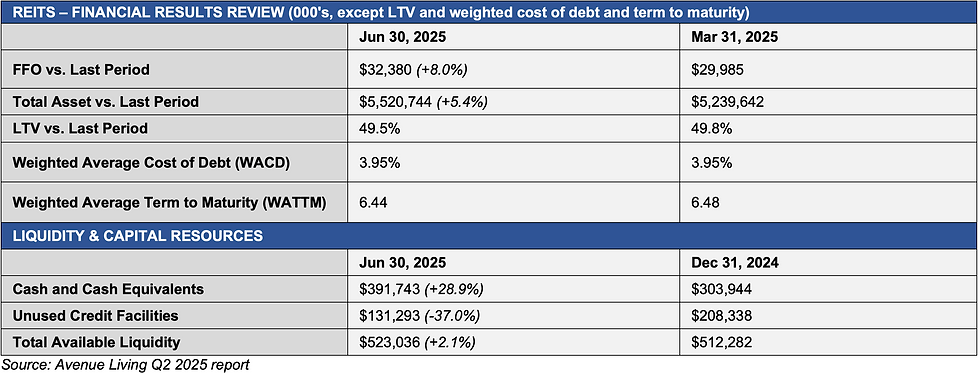
It is worth highlighting that the Trust’s total available liquidity remained solid in 2Q25. While a portion of the credit facility was drawn during 1H25, the Trust’s cash and cash equivalents increased by a larger amount than the credit withdrawn, which led to a net positive growth in the total available liquidity during the period. The Trust has over $523 million total avail-able liquidity as at end June 2025.
Unitholder Highlights

Total net assets attributable to LP unitholders increased by 3% QoQ for 2Q25 to reach $2.53 billion, which was mostly attributed to the issuance of new units totaling $118 million (up from the $112 million issuance of new units in 1Q25), despite a drag from the non-cash item in the form of a translational foreign currency loss. This translational foreign currency loss is not a real loss, but just on paper for reporting purposes given that all non-functional currency items must be reported as CAD. It should not have a fundamental impact on the Trust’s core business operations.
On the other hand, there was a 18% decline QoQ in 2Q25 in units redeemed, which reflects investors’ continued demand and confidence in the Trust’s performance and expansion strategy. Additionally, the reinvestment of distributions by unitholders would also enable the Trust to better leverage its capital for future growth opportunities.
Management’s Unit Holding Changes
According to management, their founder Anthony Giuffre and other founding partners continue to hold their investment of approximately C$380 million in Avenue Living Asset Management. Other key executives of the firm have also maintained their investment with little changes.
Unit holdings in the Trust by C-suite management members have seen a slight increase of 5% over the past year, with CEO Anthony Giuffre and CIO Jason Jogia reinforcing their commitment to the Trust. We believe this increased ‘skin in the game’ is a positive signal to unitholders that they are confident of the Trust’s future performance. The employee incentive scheme is mainly awarded through Class F units.

New Issuance by Class
As of January 31, 2025, the Trust reported a total of 151.4 million units outstanding across all classes, reflecting a net increase of 29.7 million units (+24.4%) YoY, with corresponding val-ue outstanding rising by C$487.9 million (+34.0%) for the CAD trust units and U$31.6 million (+36.6%) for the USD share classes.
In the CAD trust units, Class A, Class D and Class WB saw a stronger growth rate YoY as their share in total outstanding units have expanded. Class D, in particular, had recorded close to 4 percentage points share increase during the year, while Class F and Class W units were diluted.
In the USD trust units, we saw a similar trend as the CAD trust units, with Class A-U, D-U and Class WB-U delivering stronger growth and gaining more outstanding shares, while Class F-U and Class W-U were diluted during the year.


We note that as per the Offering Memorandum, Class W and Class W-U units are sold through Westcourt Capital. Westcourt Capital is a Toronto-based firm registered as a port-folio manager, exempt market dealer, and investment fund manager in the provinces of Ontario, British Columbia, Alberta and Quebec. The firm specializes in the sourcing, due diligence, structuring, and ongoing monitoring of alternative investments and has Assets Under Advisement (AUA) of over $5 billion since its founding in 2009. The firm’s client base are largely high-net-worth individuals and family offices, with an average ticket size for purchases of Class W and Class W-U units between $10 million to $20 million.
According to management, they do not expect investors in the Class W and Class W-U units to have significant liquidity demands on the Trust, given their long-term investment horizon and strong cash flow position.
Potential Risks to Quarterly Cash Flow Management
On the financial front, while we argue the Trust has strong available liquidity, we will need to keep a closer eye on changes in cash flow. The cash outflow, equaling to the redemption added by the distributions (net of reinvestment), amounted to $45.8 million in 2Q25, which made up about 76% of the NOI during the period. That said, the Trust’s operation is solid enough to cover all of committed distributions and payment, which should bolster inves-tors’ confidence that new issuances are not critical to the Trust’s payment commitments. Additionally, from a cash flow perspective, the cash outflow during the quarter was 42% higher than the FFO, which kept the new issuance and financial facility remain a critical role in the Trust’s quarterly cash flow management. We reiterate that the Trust’s total available liquidity remains solid at $523 million as of the end of June 2025, which is more than 11 times of the cash outflow in 2Q25.
Moreover, the Trust currently benefits from the interest rate spread between Canada and the U.S. We will also closely watch the potential impact should the interest rate environ-ments have any notable change across both of borders. On the other hand, we will also keep an eye on the fair value of the Trust’s assets, given that any changes would impact its LTV ratio. The covenants of the Trust’s bond issuance would also keep its LTV in check.
In summary, we maintain a constructive view on the Trust’s operations, underpinned by solid profitability and strong capital growth. However, attention to the Trust’s cash flow and liquidity is essential to ensure alignment with its operational needs. We will continue to monitor the Trust’s profits, redemption activity, and FFO payout ratio closely going forward.
RECAP OF 1H 2025 AND OUTLOOK FOR 2H 2025
Avenue Living Asset Management has seen a strong growth in 2025 thus far. It has recorded over $450 million in net equity inflow to support its acquisitions YTD, bringing the firm’s as-sets under management (AUM) to over $8.5 billion, compared to $7.1 billion in January this year. Following its May 2025 expansion offering targeting $350 million, which was oversub-scribed a month ahead of schedule, the Trust has extended the offering until December 15, 2025, or until a total of $550 million is raised, whichever is earlier. Based on the latest pro-spective transaction pipeline as of June 2025 as seen below, there are a total of 4,208 units amounting to $948.8 million, with c77% ($734.5 million) of these prospective transactions are in the U.S.

Canadian Real Estate Market Outlook
The composite benchmark price compiled by the Canadian Real Estate Association (CREA) has shown a 15-20% correction in housing prices since the peak in early 2022. While this trend may extend into 4Q25 and 2026, the correction appears to have moderated with sales volume gradually picking up. However, given the unresolved U.S. tariff issues and on-going economic uncertainty, we expect real estate demand in Canada to remain luke-warm over the coming quarters.
Subdued housing prices are also exerting pressure on the overall rental market, particularly in the metropolitan areas. Looking to the next few quarters, while rents may continue to soften in several major Canadian cities, we expect the areas where the Trust has higher exposure to remain relatively resilient, aided by its market positioning targeting domestic working-class households, inter-province population movement continuing to drive popu-lation growth in the prairie provinces, and the structural shortage of affordable multifamily units.
U.S. Real Estate Market Outlook
The U.S. real estate market on the other hand has also observed a similar correction since mid-2022, albeit on a smaller scale. The Case Shiller home price index YoY bottomed out in mid-2023 and has remained in positive territory since then, in spite of some fluctuations.
To offset part of the downside risk in Canada, the Trust has thus shifted its business focus into the U.S. real estate market to capitalize on diversified macro fundamentals in different states, such as a flight-to-affordability (increasing demand for rental housing amid high housing prices) and increased domestic investments that have boosted housing demand, while new starts have been muted amid the high-interest-rate environment. With more U.S. multifamily units being included in the portfolio, we believe the Trust’s risk-and-re-ward profile should be reassessed. As the market’s interest rate expectations are changing alongside an influx of foreign capital, we expect this diversification in the real estate portfo-lio from Canada to the U.S. to enable the Trust’s continued outperformance against peers for the coming year.
Potential Risk Factors: Interest Rate, U.S. Market and Class W/W-U
While we believe the Trust is well-positioned in 2H25 thanks to its flexible strategy and strong execution, we highlight three potential risks, two being high-level systematic and one spe-cific to the Trust that we should not ignore.
Interest rate risk: The Trust’s strategy of leveraging lower funding costs in Canada to invest in higher cap-rate U.S. assets is expected to be beneficial, provided the cur-rent spread persists. According to management, the Trust’s treasury team has active-ly hedged against both sides of currency volatility. We will continue to monitor if the interest rate changes in both Canada and the U.S. would have any implication on the Trust’s portfolio, and if such a shift would squeeze its margins. At this moment, we see less of such a risk given both central banks would have pressure to lower their rates in tandem.
U.S. market risk: The Trust has significantly expanded its footprint in the U.S. over the past few quarters to acquire higher cap rate projects. This will expose the Trust to market risk in both Canada and the U.S., as the portfolio is expected to have a 70% ex-posure in Canada and 30% in the U.S. by the end of 2025. On the other hand, given that the cost of property management services in the U.S. is lower than in Canada, the Trust currently outsources management of its U.S. properties to local operators. In contrast, it has a vertically integrated in-house property management team in Canada. We will continue to watch if the cap rate within the Trust’s portfolio can be sustained amid the swiftly changing economic environment, and also ensure the outsourced service pro-viders would not pose an execution or agency risk to the Trust.
Decision-making risk from Class W and W-U unitholders: As of January 2025, ap-proximately 60% of the Trust’s outstanding units are in Class W and Class W-U (CAD and USD units respectively), despite ongoing dilution from other classes over the past year. According to the Offering Memorandum, these units are sold through Westcourt Capital. Therefore, Class W and Class W-U holders could wield considerable power and exert a significant influence on the Trust’s operations, particularly with respect to cash flow management.
APPENDIX
Ongoing Analysis Review Summary Table – Avenue Living


Disclaimer
Not a Recommendation or Investment Advice: This Report does not constitute an offer to sell or a solicitation of an offer to buy any securities. It is not, and should not be construed as, investment, legal, accounting, or tax advice. The contents of this Report do not constitute a recommendation to any individual client.
Reliance and Limitations of Information: The information in this Report has been compiled from sources that the Firm believes to be reliable and accurate, including the Issuer’s offering memorandum, audited financial statements, and management presentations. However, the Firm has not independently verified all of the information contained herein and cannot guarantee its absolute accuracy or completeness. This Report is based on information and opinions current as of the date of its preparation and is subject to change without notice.
No Guarantee of Performance: This Report contains forward-looking statements and assumptions. These statements are not guarantees of future performance and are subject to risks and uncertainties. Past performance is not indicative of future results. The value of any investment may fluctuate, and investors may lose a portion or all of their principal.
Investor Responsibility: This Report does not replace an investor’s own due diligence. Investors should not rely on this Report alone when making an investment decision. It is the sole responsibility of each investor to conduct their own thorough review of the offering memorandum and all other relevant documents. All investors must be advised to seek independent legal, tax, and financial advice.
Limitation of Liability: The Firm and its officers, directors, employees, and agents shall not be liable for any loss or damage arising from the use of this Report or its contents. All parties who use this Report acknowledge that they do so at their own risk.
Risk Disclosure
Investment products sold in the exempt market are only suitable for investors who have the ability and willingness to accept the risks associated with exempt market securities. For suitable investors, it is also very important to understand the investment risks:
Risk of loss: An investment in exempt securities is risky as clients could lose a part of or the entirety of their investment amount. The investment risks pertaining to an issuer’s security will be set out in the issuer’s offering document (for e.g., offering memorandum) provided to clients and explained by their respective Enoch Dealing Representative. Please discuss these investment risks with your Enoch Representative carefully and make sure you thoroughly understand the risks prior to deciding to invest in the securities.
Limited availability of information: An issuer of exempt security is not a reporting issuer and therefore does not have to publish financial information or notify the public of changes in its business, and the investor may not, as a result, receive ongoing information about such issuer. Enoch Wealth requires all issuers to provide us with ongoing information about its business and affairs, but such information may be incomplete or not be provided in a timely matter.
Valuation risk: Valuations may be based on assumptions and projections that may not materialize, it can be complex and subjective. There may be no readily available market prices to determine the fair value of the investment.
Less regulatory oversight: Canadian securities regulatory authorities do not evaluate or endorse the merits of the security or the disclosure in an offering memorandum.
Illiquidity risk: There is a risk that you cannot resell your securities. Exempt securities cannot be resold unless: (a) the securities can be resold under available prospectus exemptions; (b) the issuer becomes a reporting issuer and a seasoning period expires; or (c) the securities are redeemed by the issuer in accordance with any redemption rights as set out in such issuer’s constating documents.
Redemption risk: Although the securities of an issuer may have redemption rights, such issuer may have limited cash flows that are insufficient to redeem such securities over a prolonged period.
Concentration risk: Investors may have a significant portion of their portfolio invested in a single company or venture. This can increase the risk of substantial losses if the investment performs poorly. Investors should be aware that these and other risks can cause investment results to vary significantly from the objectives set forth in this publication. No assurance is given that any investment strategy or market insight will be successful, and all investments carry inherent risks, including the potential loss of principal.


