
CENTURION APARTMENT REIT - ANALYSIS REPORT
Updated: Feb 13
Nov. 2025
PRESENTED BY:
GEORGE HSU - Product Manager & Toronto Branch Manager
PEIXIAN QUEK - Investment Analyst

ANALYSIS REPORT
Centurion Apartment Real Estate Investment Trust (the Trust) has generated a 3.0% return year-to- September, which will miss its targeted annual return of 7- 12%. We believe this weakness can be primarily attributed to both market factors and the Trust’s portfolio composition, such as a high geographic concentration to areas where the market rents are declining. With some of peers’ draining liquidity, the Trust’s underperformance year-to-date may self-reinforce the loop of increased redemption, and thus lead to a managed redemption. Considering the current softness in the rental market, ongoing deleveraging efforts, and a slowdown in capital deployment, we maintain a cautious outlook on the Trust’s short-term performance. It is worth noting, however, that the Trust’s underlying assets and their operations remain fundamentally sound, and its monthly distributions have not been affected. Besides, we have limited concerns about its long-term asset value, given that the Trust’s real estate holdings are generally high-quality, relatively new, and predominantly located in prime areas. Once the Canadian real estate market and broader economy stabilize and begin to recover, we believe the Trust’s asset value rebound will likely be more quickly and more pronounced than that of its peers. Our key analysis is summarized as below:
Shareholding structure leads to challenges in cash flow management. Management noted that the Trust’s unit holdings are heavily concentrated among retail investors, who account for 90% of the outstanding units held, with the remaining 10% represented by institutions. Consequently, we expect limited risks of liquidity demands from institutional investors to the Trust. However, the Trust’s retail-heavy unit holding structure, coupled with its monthly liquidity feature would inherently present challenges in cash flow management within an illiquid real estate market, particularly during periods of weak market sentiment. The recently implemented Managed Redemption Program has demonstrated management’s effort in trying to balance investors’ liquidity needs with equitable treatment across unitholders. Although this measure may inevitably dent some investors’ confidence and may require an adjustment period to rebuild, management noted the redemption pressures have eased significantly recently.
While emerging cost pressures warrant attention, pricing power is well-maintained. Rising cost pressures in 2Q 2025 have begun to weigh on funds from operations (FFO), and management is expected to focus in the near term on deleveraging and strengthening liquidity to meet redemption requests. As a result, the Trust’s recurring net income may continue to soften over the next one to two quarters, posing potential risks to profitability. Nevertheless, despite market headwinds such as a decline in average national rents, the Trust has maintained a solid occupancy rate of 93%. This resilience is supported by sustained growth in same-store rent and net operating income (NOI), underscoring its strong pricing power and the superior quality of its portfolio.
Net Asset Value (NAV) trajectory may depend on the state of the Canadian real estate market. The Trust plans to dispose of select non-core assets (with an estimated value of >$200 million) to enhance liquidity. However, there is a risk that these assets may be sold at lower-than-expected valuations, resulting in reduced sales proceeds given noncore assets might be less desirable. Additionally, an anticipated increase in Canadian real estate transactions at discounted prices for liquidity purposes could pose a downside risk to market valuations, which would indirectly impact the Trust’s asset valuations and NAV. On the other hand, we believe once the Canadian real estate market stabilizes, the Trust’s asset value should rally more quickly and more notably than its peers, thanks to the portfolio’s quality and the location advantage.
Strong performance in Student segmentthe various “return-to-office” policies across multiple regions could present a positive growth catalyst for the Trust. The Trust’s Student segment, representing 12% of total portfolio assets, had significantly outperformed the Canada Apartment segment (83%) in 2Q25. Although recent changes to Canada’s immigration policies have led to a reduction in the number of international students, the Trust’s Student housing segment achieved a 9.6%increase in NOI, driven by robust growth in both new tenants and average rental rates. At the same time, we note that since October, many public and private sector organizations have begun requiring employees to fully return to in-office work. This trend could bolster demand for the Trust’s residential properties located near downtown areas, supporting a favorable growth outlook.
CENTURION REIT – OVERVIEW
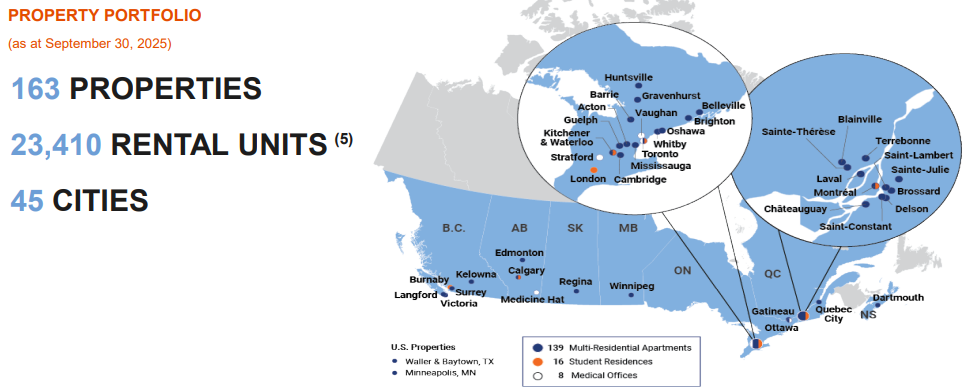
Sample Portfolio Properties

Source: Centurion Presentation Q3 2025

RETURNS: NEAR-TERM UNDERPERFORMANCE MAY NOT SHADOW THE UNDAMENTALLY SOUND OPERATION

Centurion Apartment Real Estate Investment Trust (The Trust) has delivered 2.98% return year-to-September, lower than the 7.31% return during the same period last year. The muted return could be mainly attributed to (1) a lower interest rate environment, (2) the Trust’s high geographic exposure to Ontario and British Columbia – which combined account for 52% of the total portfolio, and where the overall market’s average advertised rents are declining amid weaker demand from immigrants and temporary residents, and (3) elevated overall market’s months of inventory, particularly in the Greater Toronto Area and Metro Vancouver, which has continued to weigh on the broader real estate market.
From a longer-term perspective, although Toronto and Vancouver are amongst Canada’s most populous and economically significant provinces, both operate under stringent rent control laws that limit annual rent increases that can be imposed by landlords. In Ontario, the maximum rent increase is at 2.5% for 2025, and 3.5% for 2025 in British Columbia. These policies help protect tenants from arbitrary rent increases but constrain landlords’ ability to offset the effects of rising operating costs such as maintenance and insurance expenses. As inflationary pressures continue to elevate costs, Centurion’s properties in these provinces may face margin compression.
At the same time, demographic trends in both provinces continue to drive long-term housing demand. Ontario remains Canada’s main destination for both international and interprovincial migration, while British Columbia, despite a smaller absolute population, continues to attract immigrants due to its high quality of life. These population trends suggest that the underlying demand for purpose-built rental housing is likely to remain robust in both markets, despite near-term rent control constraints. We will continue to monitor closely how Centurion strikes a balance between the opportunities and challenges that it faces in the markets that it has an exposure to. Additionally, investors should note that although rental rates across the broader market remain under pressure, the Trust’s real estate holdings have maintained stable performance, with some even showing modest growth. This demonstrates the resilience of its asset value and provides a solid foundation for sustaining consistent and stable distributions.
Moreover, the Trust has a relatively higher exposure to newer units in its portfolio, making it more vulnerable during economic downturns, although such assets also tend to benefit more during market recoveries. While the Trust recorded a modest NAV increase in January from $24.26 to $24.34, this gain was fully erased in February with the NAV falling back to $24.24 and remaining flat ever since (Class A). We highlight a downside risk that the NAV may further decline should the Canadian real estate market remain lackluster over the coming year. While long-term investors may consider accumulating on the dip, those with liquidity demand in the near term should identify and acknowledge such a risk.
The Trust is expected to deliver an annual return of 4.0-4.5% this year, below its target range of 7-12%. With market headwinds – including an oversupply in the condo market across major Canadian cities, temporarily reduced immigration levels and near-term economic uncertainty likely to persist, we see a risk of continued underperformance in the near term. On the other hand, the Trust’s proactive management and ownership of newer, well-located assets, leads us to be less concerned about the quality and long-term value of their assets. Once the trade uncertainty with the U.S. eases and the immigration policy normalizes, we expect the Trust’s performance to recover.
BUSINESS UPDATES: NEAR-TERM FUND FLOW UNDER PRESSURE DESPITE QUALITY ASSETS
While the Trust has strengthened its total available liquidity to $232.7 million as of August 2025 - up from below $150 million during 4Q23 to 3Q24, and rising to over $200 million since 4Q24 following a deleveraging strategy, its liquidity coverage still remains tight. Specifically, the liquidity balance represents 1.8x the net cash outflow (redemptions plus net distributions) for both 1Q25 and 2Q25, which averaged approximately $130 million per quarter. Faced with an extraordinary scenario of a surge in retail redemptions between July 16 to August 15, the Trust may be encountering challenges in its cash flow despite its financial health and ownership of high-quality assets. The Trust’s monthly redemption feature further exacerbates such a vulnerability, underscoring the need for the Trust to shift its focus towards liquidity management in the near term.
Background of the Managed Redemption Program
The challenging market conditions year-to-date has led to some competitors electing to suspend redemptions, resulting in (1) a slump in new issuances by the Trust in 2Q25 (down nearly 50% to $101 million from $195 million in 1Q25), and (2) increased liquidity demand from both institutional and retail investors, given the Trust’s monthly liquidity feature compared to quarterly, as in the case for many of its peers. As per Centurion, redemptions spiked unexpectedly from $38 million in July to $104 million in August and $90-100 million in September. Therefore, to ensure fair treatment of unitholders, the Trust has opted to manage redemptions on a pro-rata basis, which will affect all redemption requests made from July 15 onward. This managed redemption program is the first time in its 16-year history. It is worth noting that, according to the management team, following the launch of the Managed Redemption Program, approximately one-third of the redemption requests in August and September were rescinded. This indicates that the surge in redemption activity was primarily driven by market sentiment rather than genuine liquidity needs. The rescinded redemption requests also helped ease part of the Trust’s cash flow pressure.
To strengthen the Trust’s capital base, management has (1) reduced its asset management fee to 90 basis points (from 100 bps previously) until the managed redemption program is ceased and normal redemptions resume, (2) initiated a review and potential sale of non-core assets expected to generate over $200 million in equity proceeds, and (3) begun engagement efforts with international investors, particularly those in Europe and America as they have expressed their interest in Canadian real estate.
Alongside with the aforementioned three approaches to enhance its capital base, the Trust has also launched a $200 million capital raise by issuing a 2% non-dilutive discount to NAV for all new subscriptions from September 2, 2025 to on or before December 1, 2025, or until the targeted allocation is fully subscribed to further encourage capital inflows during this downturn. On the other hand, the asset managers have also pledge not to redeem any of their units until the redemption queue is fully cleared.
Details of the Managed Redemption Program
1. Phase I Controlled Redemption Program (Completed)
Under this program, investors who submitted redemption requests between July 16 and October 15 received a five-year unsecured Centurion Operating Trust Note (COT Note) bearing an interest rate of 2.57%. Interest is paid monthly on the same day as the regular monthly distribution.
Centurion announced that the first pro-rata redemption payment, totaling CAD 20 million, was successfully completed on October 10, 2025, covering redemption requests submitted on or before August 15, 2025. Subsequently, the second pro-rata redemption payment, covering redemption requests on or before September 15, 2025, was successfully completed on October 17, 2025.
For non-registered accounts, redemptions are subject to capital gains tax, and interest earned from the COT Notes is also taxable income. For registered accounts, the potential tax implications are more significant—since COT Notes are not qualified investments for registered accounts, holding them could trigger a 50% tax on fair market value. Given these potential and substantial tax consequences, especially for registered account investors, Centurion has suspended this redemption arrangement.
2. Phase II Controlled Redemption Program (Implemented Following the November 6 Vote)
On November 6, 2025, unit holders voted on proposed amendments under the Third Amended and Restated Declaration of Trust, which included updates to the redemption terms. The amendment was approved on the same day, with the following key changes:
1. Liquidity Arrangement
Mid-month redemption notices
Redemption settlement cycle extended to T+90 days (previously 30 days)
2. Pro-Rata Redemptions
Investors submitting redemption requests may continue holding Centurion Apartment REIT units
Investors who have submitted redemption requests will continue to receive distributions until their units are formally redeemed
Centurion will evaluate redemption payment ratios monthly and make pay-ments accordingly based on the announced redemption ratio
3. Treatment of Unredeemed Balances
Holders have 10 business days to choose one of the following options:
Roll over the unredeemed balance into the next month’s pro-rata re-demption pool; or
Receive the unredeemed balance in the form of a Centurion Operat-ing Trust Note (COT Note)
Term: Fixed 5 years
Interest: Paid monthly at 2.57%
Principal: Repaid in full at maturity
We will continue to monitor the progress of the redemption plan to ensure it operates as expected by management and maintains sound liquidity management.
On the other hand, the Trust will continue to maintain a prudent focus on liquidity management with respect to acquisitions and indebtedness. No single asset may be acquired if the acquisition cost exceeds 15% of the Trust’s gross book value. The Trust’s overall indebtedness will not exceed 55% of the total fair market value of its real estate portfolio, nor 75% of the value of any individual real estate asset, except in the case of a development property, where the limit is set at 85% of its value.
In an information circular dated October 6th, 2025, Centurion had also announced a review of its Third Amended and restated DoT made as of January 13th, 2022, in order to modernize and align it with current market practices. The review focused on improving the operational flexibility. Overall, Centurion found its existing DoT remains broadly consistent with peers, so no major additional changes are needed beyond the points listed below. The amendments to the Third Amended and Restated Declaration of Trust were approved by unitholders on November 6, with approximately 25% of the units voted and 99.719% approval in favor of the proposed changes.
Permit the Trustees to Create New Classes of Units. The updated DoT gives Trustees more flexibility to create new types or classes of units when needed, with investor (Unitholder) approval only required if there are special privileges in any new class of units, such as priority rights or security interests over existing units.
Amend the Redemption Provisions to Provide Additional Flexibility. Before the amendments, Centurion was required to redeem Trust Units on the 15th day of ev-ery month, subject to 30 days’ notice. Changing the notice period to 90 days, as is the case for most funds, would provide for more time to plan and manage its liquid-ity requirements. Additionally, Trustees would also be able to get a pro-rata partial cash redemption should full cash redemption not be available.
Remove Limitations on Transfer. Before the amendments, Trustee approval was required before Trust Units can be transferred, which limits liquidity and slows down transactions. Removing these limitations on transfer would allow investors to transfer their units freely, provided the transfers comply with securities laws and the Trust’s policies. This would make it easier for investors to trade units and for dealers to process transactions more efficiently, improving the overall flexibility and mar-ketability of Centurion’s units.
Remove the Investment Guidelines from the DoT. Before the amendments, Centurion’s investment guidelines were highly detailed and embedded in the DoT, meaning any change requires a Unitholder vote. After the approval to the amend-ments, these detailed rules will be taken out of the DoT and instead let Trustees ap-prove them separately. This would give the Trust more agility to respond to chang-ing market conditions, while still maintaining broad oversight through a stated “purpose of the trust” section to ensure continued compliance with regulations.
Technical Amendments. Electronic communications will be allowed as an alter-native to mail delivery, and voting can be done by written resolution. These practi-cal improvements aim to streamline investor communication and align Centurion’s governance with current technological and market standards.
OPERATIONAL HIGHLIGHTS:
PRICING POWER WELL MAINTAINED
The Trust’s overall portfolio occupancy remained stable at approximately 93% in both 2Q25 and 1Q25, with same-store rent in 2Q25 growing 1.4% QoQ and 5% YoY, in turn narrowing the gap-to-market to 7% in 2Q25 from 8% in 1Q25. This highlights the Trust’s pricing power and portfolio quality in the face of prevailing market headwinds, especially given that average national rents had declined 5% YoY. Same-store NOI margin improved to 64.5% from 64.3% during the same period, underpinned by rent growth and enhanced operational efficiency. Meanwhile, the weighted unstabilized ratio has been rising (17.8% in 2Q25, 17.5% in 1Q25, 15.9% in 2024), indicating countercyclical capex activity, consistent with peers. This is further evidenced by an increase in capex in 2Q25 to $13.6 million, versus $5.2 million in 1Q25 and $12.3 million in 2Q24.
On a YoY basis, same-store revenue and NOI both grew by 5-6%. The Student segment outperformed the Apartment segment with a NOI YoY growth of 9.6% and 5.3% respectively. The outperformance in the Student segment was driven by new tenants, which grew 25.9% YoY for stabilized properties, and in turn resulting in an 11.5% YoY increase in average rent/unit to $949. In the Apartment segment, the 4.2% YoY increase in rent was attributed to renewals, which stood at 4.3% and 2.9% for stabilized Canadian and US apartments respectively.
The Trust appeared to slow down its expansion pace, as revenue was flat on a QoQ basis in 2Q25. This echoes with management’s stated near-term priority to deleverage and maintaining quality of the Trust’s existing assets, rather than pursuing new assets in a challenging Canadian real estate market. The Trust’s average cap rate remained at 4.4% in 2Q25, consistent with market averages as well as historical trends.
Additionally, investors should note that since October, many public and private sector organizations — including several financial institutions — have begun requiring employees to fully return to the office. Notably, the Ontario government has mandated that all public servants work onsite five days a week starting January 5, 2026. This shift is likely to boost demand for the Trust’s residential properties located in and around urban centers, supporting a favorable growth outlook.
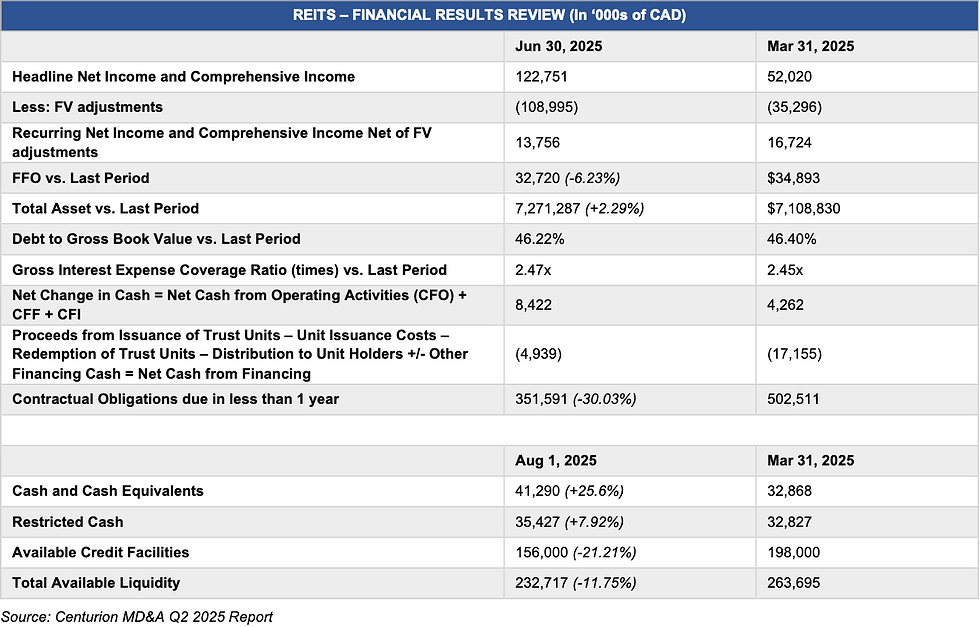


Potential Risks to NAV Changes
As part of the Trust’s plan to meet investors’ redemption requests, the Trust has begun the sale of its non-core assets to unlock over $200 million of equity value, which was initially planned to be redeployed into acquisitions. Assets would be marketed in monthly tranches, following which there would be a three-week negotiation process with top bidders, a 30-day due diligence process and another 30 days to close. Management expects the sales of these assets to become firm between November 2025 and February 2026, and will strategically tap on its credit lines to satisfy its loans once they have visibility on when the sale proceeds are expected.
Although selling in the fall usually provides for the most bid depth, there are risks stemming from the Trust realizing lower than anticipated valuations and in turn lesser proceeds of sale, given non-core assets are typically in locations that are less desirable. Moreover, the potentially new external investors seeking to buy on market dip may also pose a downside risk to the Trust’s NAV. We will continue to monitor the progress of the asset sales and composition of the Trust’s portfolio on an ongoing basis.
On the other hand, we also flag a risk that an increase in Canadian real estate transactions settling at lower selling prices to unlock liquidity could exert downward pressure on market valuations, and thus may indirectly influence the Trust’s asset appraisal and NAV, given its significant asset concentration in Canada.
FINANCIAL HIGHLIGHTS:
CONTINUING TO DELEVERAGE; ALL EYES ON NAV TREND
Headline net income in 2Q25 was $122.8 million, compared to $52 million in 1Q25. The increase was mostly driven by higher fair value adjustments on investment properties, which are non-cash and do not impact the Trust’s funds from operations (FFO). Excluding these fair value adjustments, recurring net income decline to $13.8 million in 2Q25 (versus $16.7 million in 1Q25 and $18.4 million in 2Q24), consistent with the FFO decrease of 6.2% QoQ and 2.2% YoY.
The decline in recurring net income can be mainly attributed to (1) lower income from equity accounted investments due to the strategic transition from mortgage investments into long-term development assets (Canadian Mortgage & Equity Investment made up 2.2% of the total portfolio in 2Q25 versus 5.4% in 2Q24), (2) higher trailer fees, (3) increased G&A expenses stemming from higher office expenses, advertising costs, and one-time non-recurring legal fees, and (4) foreign currency losses. Given the Trust’s near-term priority to strengthen its liquidity for redemptions, we believe this decline in net income would likely persist for the next 1-2 quarters until the Trust can redeploy capital to drive returns again.
We will closely monitor whether the Trust can maintain cash flow and financial stability during the period of the managed redemption program. On the other hand, our recent conversations with management indicate that as the market gradually absorbs most of the negative news, coupled with the Trust’s solid operations and consistent monthly distributions, redemption pressures have eased significantly recently.
Total assets increased by 2.3% QoQ, while the Trust’s debt-to-gross book value ratio declined slightly from 46.2% in 2Q25 from 46.4% in 1Q25, which was in line with management’s deleveraging strategy. Management stated their target of maintaining this ratio below 55%. However, their focus remains on maintaining more liquidity in the near term to meet redemption requests from investors.
As stated earlier in this report, the Trust has launched a $200 million capital raise aimed at strengthening the Trust’s liquidity position, unlocking value from recent acquisitions and improving operational performance. Coupled with an improvement in the Trust’s Gross Interest Expense Coverage ratio from 2.45x to 2.47x, and a 30% reduction in its contractual obligations due in less than 1 year, investors should be assured in the Trust’s ability to meet its obligations as they fall due. Moreover, 97% of the Trust’s mortgage liabilities are fixed rate loans, which aids cash flow planning whilst mitigating interest rate volatility.
The Trust has a total available liquidity of $232.7 million as of August 2025, compared to below $150 million during 4Q23 to 3Q24, to over $200 million since 4Q24 following deleveraging efforts. The Trust is actively exploring additional liquidity sources, including potential new or extended lines of credit with banking partners, discounted capital raises, and the sale of non-core assets. We will continue to closely monitor the total amount of undrawn credit facilities in the Trust to ensure overall liquidity risk does not increase.

Unitholder Highlights

As of June 30, 2025, the Trust reported a total of 182.4 million units outstanding across all classes, representing a net increase of 3.4 million units (+2%) from Q4 2024. According to management, the Trust’s unitholder base remains heavily concentrated in the retail channel, with 90% of its outstanding units held by retail investors and the remaining 10% by institutions. We therefore view the risk of liquidity demands from institutional investors as limited due to the relatively small exposure. However, given retail investors are more likely to be influenced by market sentiment, the Trust’s shareholding structure, together with its monthly redemption feature could inherently lead to more volatile cash flows, making liquidity management more challenging in a market downturn. On the other hand, the Trust is actively engaging with several overseas investment institutions in hopes of attracting more institutional investors who recognize the long-term value of Canadian real estate. The participation of these potential institutional investors would also help enhance the Trust’s cash flow management.
Centurion Asset Management Inc is the asset manager of the REIT. Together with its related parties, it holds 68,000 Class A units and 2,794,408 Class F units, representing 1.57% of total units issued.
Potential Risks to Near-Term Profitability and Valuation Methodology
The decline in FFO, while currently limited to one quarter, warrants close monitoring as we are concerned that this trend may persist over the next few quarters. According to the Trust’s half-year report, the decrease was due to a combination of the transition of mortgage investments into long-term development assets, as well as temporary impacts from lease-up activity and rent concessions. We believe the Trust’s focus on its managed redemption program and the corresponding increase in cash or cash-equivalent holdings could potentially weigh on the Trust’s ability to generate profitability in the near-term. Given the current headwinds in the real estate market, there is a need to closely watch whether this trend continues.
Another area of focus is the Trust’s fair asset value. While we are less concerned regarding asset quality given the portfolio is comprised mostly of newer properties in prime locations, we are mindful of potential spill-over effects from the lackluster real estate market in Canada. Any downward pressure on valuations in Canada could affect the Trust’s mark-to-market methodology, and in turn drag on NAV.
OUTLOOK FOR 1H 2026
Looking into 1H26, while rents may continue to soften particularly in the Trust’s core markets of Ontario and British Columbia, Centurion is expected to remain relatively resilient given the overall tight rental market conditions in Canada. According to a joint report authored by Urbanation, BILD, and Finnegan Marshall in the Greater Toronto area, rental demand in the GTA is projected to grow by 232,000 households during the next 10 years. Over the same period, the total supply of purpose-built and condominium rentals is expected to increase by 111,000 units, resulting in a projected supply deficit of 121,000 rental units. Therefore, while we are less concerned about the long-term value of Centurion’s Canadian apartment assets, we remain more cautious about its near-term NAV trajectory and profitability. We also note that the various “return-to-office” policies across multiple regions could present a positive growth catalyst for the Trust.
Key Positive Factors
Strong Asset and Cash Flow Fundamentals: The Trust has maintained a stable portfolio occupancy rate of approximately 93%, with same-property rent and NOI increasing by 5–6% year-over-year, demonstrating resilience in a soft rental environment. The student housing segment continues to outperform, with NOI up 9.6% and average rent up 11.5%, highlighting strong underlying demand.
Sustained Rental Demand Recovery: As “return-to-office” policies are gradually reinstated across major Canadian cities, urban apartment demand is rebounding. Combined with student housing accounting for approximately 12% of total assets, and continued recovery in both domestic and international student demand, the Trust’s rental income and occupancy levels are expected to remain strong.
Improved Liquidity and Financial Flexibility: Through deleveraging, selective non-core asset sales, and a discounted unit offering program, the Trust has successfully increased available liquidity to CAD 232 million. Additionally, 97% of its mortgage debt is fixed-rate, effectively mitigating interest rate risk and enhancing cash flow stability.
Although we believe the Trust will benefit significantly when Canadian real estate market starts to recover, there are three potential near-term risks that we should not ignore.
Profitability risk: The steps taken by the Trust to increase its liquidity position to meet redemption requests would occupy its capital resources, which may delay capital deployment and potentially drag on profitability. We flag a risk that the Trust’s return may remain subdued until the normal redemptions resume. Only when the Trust is able to effectively redeploy capital into quality acquisitions and strategically increase leverage to enhance profitability can its returns recover to the targeted range.
Market and valuation risk: Management has stated that they have seen market paralysis and slower decision-making in the current macroeconomic environment. With Canadian home prices decreasing from factors such as some segment’s oversupply and slower population growth, there is also an indirect downside risk to the Trust’s asset valuation, which would in turn weigh on NAV. While this would be a non-cash unrealized fair value adjustment, it may nonetheless weigh on investor sentiment. We will continue to closely monitor whether broader market risks could spill over and translate into downside pressure on the Trust’s NAV.
Policy risk: Student residences account for 11.7% of the Trust’s portfolio, and have a higher proportion of new tenants due to yearly student turnover. With the federal government implementation of a cap on international students as part of their 2025-2027 immigration levels plan, there is a risk of a decline in occupancy rates and market rents, which would thus in turn limit rent growth moving forward.
APPENDIX


Disclaimer
Not a Recommendation or Investment Advice: This Report does not constitute an offer to sell or a solicitation of an offer to buy any securities. It is not, and should not be construed as, investment, legal, accounting, or tax advice. The contents of this Report do not constitute a recommendation to any individual client.
Reliance and Limitations of Information: The information in this Report has been compiled from sources that the Firm believes to be reliable and accurate, including the Issuer’s offering memorandum, audited financial statements, and management presentations. However, the Firm has not independently verified all of the information contained herein and cannot guarantee its absolute accuracy or completeness. This Report is based on information and opinions current as of the date of its preparation and is subject to change without notice.
No Guarantee of Performance: This Report contains forward-looking statements and assumptions. These statements are not guarantees of future performance and are subject to risks and uncertainties. Past performance is not indicative of future results. The value of any investment may fluctuate, and investors may lose a portion or all of their principal.
Investor Responsibility: This Report does not replace an investor’s own due diligence. Investors should not rely on this Report alone when making an investment decision. It is the sole responsibility of each investor to conduct their own thorough review of the offering memorandum and all other relevant documents. All investors must be advised to seek independent legal, tax, and financial advice.
Limitation of Liability: The Firm and its officers, directors, employees, and agents shall not be liable for any loss or damage arising from the use of this Report or its contents. All parties who use this Report acknowledge that they do so at their own risk.
Risk Disclosure
Investment products sold in the exempt market are only suitable for investors who have the ability and willingness to accept the risks associated with exempt market securities. For suitable investors, it is also very important to understand the investment risks:
Risk of loss: An investment in exempt securities is risky as clients could lose a part of or the entirety of their investment amount. The investment risks pertaining to an issuer’s security will be set out in the issuer’s offering document (for e.g., offering memorandum) provided to clients and explained by their respective Enoch Dealing Representative. Please discuss these investment risks with your Enoch Representative carefully and make sure you thoroughly understand the risks prior to deciding to invest in the securities.
Limited availability of information: An issuer of exempt security is not a reporting issuer and therefore does not have to publish financial information or notify the public of changes in its business, and the investor may not, as a result, receive ongoing information about such issuer. Enoch Wealth requires all issuers to provide us with ongoing information about its business and affairs, but such information may be incomplete or not be provided in a timely matter.
Valuation risk: Valuations may be based on assumptions and projections that may not materialize, it can be complex and subjective. There may be no readily available market prices to determine the fair value of the investment.
Less regulatory oversight: Canadian securities regulatory authorities do not evaluate or endorse the merits of the security or the disclosure in an offering memorandum.
Illiquidity risk: There is a risk that you cannot resell your securities. Exempt securities cannot be resold unless: (a) the securities can be resold under available prospectus exemptions; (b) the issuer becomes a reporting issuer and a seasoning period expires; or (c) the securities are redeemed by the issuer in accordance with any redemption rights as set out in such issuer’s constating documents.
Redemption risk: Although the securities of an issuer may have redemption rights, such issuer may have limited cash flows that are insufficient to redeem such securities over a prolonged period.
Concentration risk: Investors may have a significant portion of their portfolio invested in a single company or venture. This can increase the risk of substantial losses if the investment performs poorly. Investors should be aware that these and other risks can cause investment results to vary significantly from the objectives set forth in this publication. No assurance is given that any investment strategy or market insight will be successful, and all investments carry inherent risks, including the potential loss of principal.


